 Vira-asana - The Hero Pose
The Sanskrit word vira means hero, brave or eminent man, or warrior.
At first sight this asana seems simple. Nevertheless, within the first years of practice this traditional position sitting is given to much hardly. Pupils complain of sensation of burning in hips, a pain in knees and anklebones.
To scorn Vira-asana does not follow, even if it seems to you, that it brings one crucifyings. Though its effect is swept up not at once, the Hero pose is very useful. In Vira-asana we improve mobility of knees and anklebones, and also we study to turn hips inside. The pose reduces pressure in feet, improves digestion and relieves of unpleasant sensations in a stomach. Besides, Vira-asana - one of traditional positions for meditations. If it is carried out correctly, it is possible to abide in it some minutes, observing for the internal sensations. In other words, this asana develops sensibleness which is a corner stone of all practice of yoga.
The basic errors:
- Do not allow stops to part in the parties;
- Do not sit on heels;
- Keep a natural bend of a waist.

 Sirsha-asana - The Head-stand
The Sanskrit word sirsha means head. This posture is the well-known headstand posture, and perhaps second only to the padma-asana or lotus posture, is widely identified with the practice of Yoga.
To sit down on heels the person on the south. A head to put on a floor. Hands to clasp a nape: the right hand lays at a nape, left - on right (at women to the contrary - right on left). Distance between elbows to equally length of one forearm. To lift a basin, feet to straighten. To lean against a cinciput. To tighten direct feet is closer to a trunk, to lift the bent feet, then to straighten. To be late in a pose at first for one minute, gradually increasing time. In a final phase of development of this pose to stand 10 minutes Breath any. Then to return to a starting position: at first to bend feet, then slowly to lower them on a floor. To sit down on knees, a head to lower on a floor, to enclose under a forehead fists: the left fist on a floor, right - on left, (at women - to the contrary: left is closer to a head).

 Ardhachandra-asana - The Half-moon Pose
The Sanskrit word ardha means “half,” and the word chandra means “moon,” thus, this is the “half moon” posture.
Actually for this pose there are no contra-indications, it is simple enough. To rise, feet are wider than shoulders, stops are parallel. With a breath to lift hands through the parties to level of shoulders. With an exhalation to bend aside to the left (bent) foot (women - to right). The left palm to put on a floor and to lean against it. The right foot to lift aside and to arrange in parallel a floor, the Right hand to put on the right hip. To be late in a pose on an exhalation. With a breath to rise. With an exhalation to repeat in other party. Attention in area of kidneys. Repeat ardha-chandra-asana two to three times.

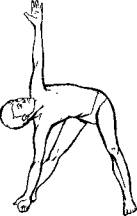
 Trikona-asana - The Triangle Pose
The Sanskrit word tri means three and kona means corner or angle. Thus “three corner or three angle posture” is often called the triangle posture. This posture is also known as the utthita trikona-asana. Utthita means stretched or extended thus this is the Extended Triangle Pose.
With a full breath to lift direct hands through the parties palms downwards (women to the contrary, - palms upwards) to level of shoulders. With a full exhalation, not lowering hands to incline a trunk sideways and hardly forward, simultaneously having developed palms of hands forward so that the middle finger of the hand lowered downwards concerned with the back party of the big finger of the foot with the same name, other hand has been lifted vertically upwards (at weak flexibility the hand brush simply aspires to fingers of the foot with the same name). Hands on one vertical straight line. The head turns in the party opposite to an inclination (upwards). The person and a sight are converted to a palm of the hand lifted upwards. In a pose to be on a delay of breath after an exhalation to weariness first signs. With a full breath to return a trunk in vertical position, hands in the parties, palms are converted forward, and to execute exercise with an inclination in other party. To return to vertical position and with a full exhalation, having turned palms upwards (women carry out to the contrary - downwards), slowly to lower hands along a trunk in a starting position. To execute 4 times.
 Chakra-asana - The Wheel Pose
Chakra, from the root cak (”to move”) means wheel and therefore this is the Wheel Posture.
The cakra-asana is also known as the urdhva-dhanurasana. Urdhva means raised, elevated or upright and dhanur means bow. Both “wheel posture” and “raised bow posture” describe the appearance of this asana.
To bend feet in knees and to put heels to buttocks on width of hips. Hands to put palms on a floor under humeral joints, fingers to feet. To raise a trunk, having caved in in a back and to put a head a cinciput on a floor. It is a little to stand, getting used to new position of a body and to continue to be wrung out on hands from a floor before full straightening of hands and feet (to execute the gymnastic bridge). In a pose to be on free breath to weariness first signs. At end of a static part pose to execute a breath and slowly exhaling, slowly to lay down on a floor and to relax. To execute 4 times (or 1 time at two-minute endurance).


